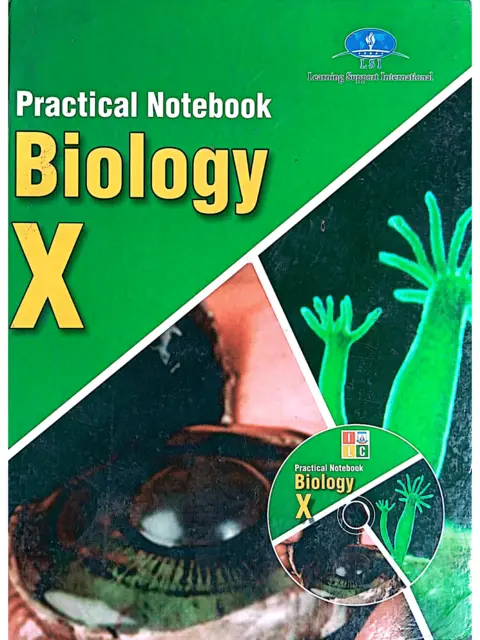
The Biology Practical Notebook for Class 10 is an essential resource for Matric students preparing for their board examinations. The aim of this notebook is to explore the role of practical work in learning Biology at the school level. It includes comprehensive introductions for each topic, clear principles, and facts designed to give a deeper insight into natural processes.
Key Features:
Updated Syllabus: Aligned with the latest requirements for all Punjab and Federal Boards.
Comprehensive Content: Includes interesting facts, mind twisters, and clear experiment guidelines.
Visual Learning: Features diagrams and charts to help distinguish between smoker and non-smoker lungs, kidney structure, and more.
Table of Contents (Experiments Included):
1. Gaseous Exchange
10.1: Activity to compare the breathing rate at rest and after exercise.
10.2: Experiment to find out how much air a person can take into his/her lungs.
10.3: Demonstration of the presence of carbon dioxide in the exhaled air.
10.4: Demonstration of the presence of tar in cigarette smoke and difference between lungs of smokers and non-smokers.
2. Homeostasis
11.1: Examination of the structure of the kidney (Sheep kidney/model).
3. Coordination
12.1: Observation of response quickness in coordination types.
12.2: Experiment to observe contraction in shin muscles of a frog.
12.3: Identify different parts of a longitudinal section of the eye (sheep or bull).
4. Support and Movement
13.1: Investigation of the nature of bone (using NaOH and dilute HCl).
5. Reproduction
14.1: Observation of binary fission in Amoeba.
14.2: Observation of budding in yeast.
14.3: Examination and cultivation of a bulb (onion).
14.4: Examination and cultivation of a corm (colocasia).
14.5: Examination of rhizome (ginger) and stem tuber (potato).
14.6: Propagation by stem cuttings (Rose/Bryophyllum).
14.7: Examination of a mustard flower (Brassica campestris).
14.8: Examination of gram seed and maize grain.
6. Inheritance
15.1: Recording class fellows’ heights to predict variations (graphical representation).
7. Man and His Environment
16.1: Investigation of an ecosystem (e.g., an aquarium or pond).
8. Biotechnology
17.1: Investigation about the role of yeast and bacteria in the fermentation of flour and milk.